What if every step you take, every time you stand up from a chair, or every time you reach for something on a shelf is actually your body working with one of the most powerful forces in the universe?
I was recently listening to a podcast with Dr Brennan Spiegel discussing his book Pull, where he presents a new way of thinking about the human body. He has explored how gravity has shaped our evolution and how our ability to move, adapt and thrive depends on continually responding to its constant pull.
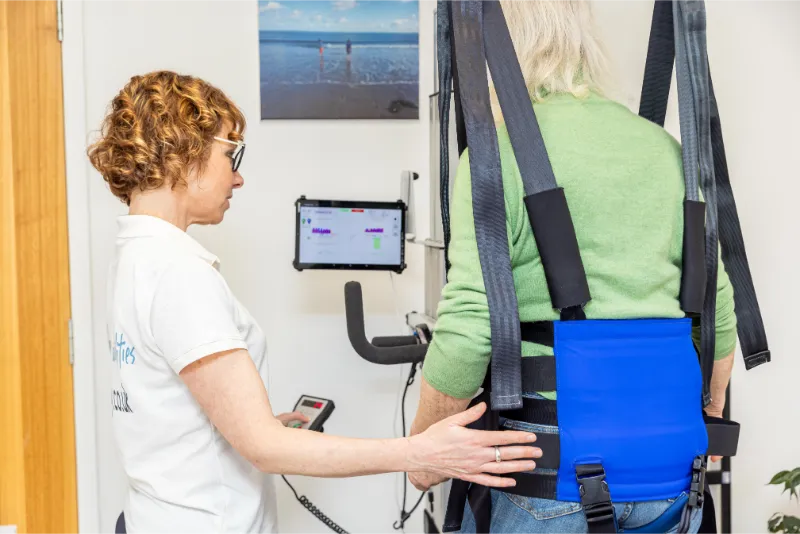
As I listened, I kept thinking about our clients. Every day we help people stand taller, walk more confidently, improve their balance and regain their independence. I’d never really thought about it before, but so much of rehabilitation is helping people work with gravity instead of feeling as though they’re constantly fighting against it.
Standing tall matters
One of the things we perhaps appreciate least is just how much work goes into keeping us upright.
Many neurological or balance problems, as well as the natural ageing process, make it harder to maintain an upright posture against gravity. Gradually, people can become more stooped or find themselves looking down towards the floor. This isn’t a sign of weakness or laziness, it’s often the result of changes in muscle strength, flexibility, balance and the way the brain controls movement.
Our postural muscles are sometimes called our anti-gravity muscles because their job is to keep us upright despite gravity’s constant pull. Like any muscles, if they aren’t challenged regularly, they become weaker and less effective.
A rounded posture can reduce the space available for the lungs to expand fully, making breathing feel less efficient. There is even some emerging thinking that maintaining an upright posture may influence how our gut functions.
Perhaps most importantly, posture changes affect how we move through the world. Looking down instead of ahead reduces the visual information we use for balance. Steps often become shorter, walking becomes less fluid, and confidence gradually starts to decline.
One of our goals in neurological physiotherapy is to help people find the strongest, most comfortable and most efficient position for their body. We don’t ask people to stand taller because posture has to look a certain way. We help people stand taller because it allows them to move, breathe and live more easily.
Movement builds resilience
One of the ideas that really resonated with me is what Dr Spiegel describes as becoming “gravity resilient.”
Our bodies become stronger because gravity provides a challenge. Every time we stand, walk, climb stairs or reach overhead, our muscles, bones, heart, balance systems and brain all respond to that challenge. The more we move, the better these systems work together.
Why moving less can make movement feel harder
Many of the people we see in our clinic have started moving less because movement has become difficult or frightening.
Perhaps they’ve experienced dizziness. Perhaps they’re living with Parkinson’s disease, multiple sclerosis or recovering from a stroke. Perhaps they’re worried about falling.
That response is completely understandable.
The challenge is that when we stop moving, our brain receives less information. Muscles become weaker, balance becomes less automatic, confidence gradually reduces and everyday activities begin to feel more difficult.
One of the most rewarding parts of neurological physiotherapy is helping people rebuild that relationship with movement- gradually, safely and at a pace that feels achievable.
Movement helps your whole body
One of the things I loved most about Dr Spiegel’s perspective is that it reminds us that movement benefits far more than our muscles.
When we move regularly, our leg muscles help pump blood back towards the heart, our bones stay stronger through weight-bearing activity, our digestive system functions more efficiently, our joints stay mobile, and our nervous system becomes more adaptable.
Exercise or movement isn’t simply about burning calories or improving fitness. It’s about keeping all of the body’s systems working together in the way they were designed to.
Often in the clinic when we get the right body alignment with the right muscles working and someone learns to stand a little taller, they often tell me they feel lighter on their feet. Their posture hasn’t become perfect, but they’ve discovered a more efficient way of organising their body against gravity. When we’re upright, our muscles, joints and balance system can work together more effectively. Listening to the podcast it occurred to be that we are helping people move with gravity rather than constantly feeling like they’re fighting against it.
If you’re feeling as though you’re constantly battling against your body, we’d love to help you rediscover a more confident and efficient way of moving. Sometimes small changes can make a big difference.