Falls are common, but not inevitable
Have you started holding onto furniture as you walk around the house? Perhaps you’ve noticed you’re less steady on your feet, or you’ve had a fall and are now frightened of falling again.
When our balance starts to deteriorate, our confidence often follows. We become more cautious, avoid certain activities and gradually our world starts to shrink.
But here’s the important thing: falls are not an inevitable part of ageing. Although our strength and balance can change as we get older, there is a lot we can do to improve them.
Why do we fall?
Balance is complex and relies on several systems working together. The main systems that help us to balance are –
- Vision
- The vestibular System in our inner ear
- Sensory feedback from our feet and joints
- Muscle strength in the body (mainly the legs and core)
Our reaction times are important so that we can respond quickly if we trip or lose our balance. If we can’t take a fast, big step in any direction it is hard for our body to react to stop us falling.
Other factors that can increase the risk of falls are medical conditions, including stroke, Parkinson’s, MS and peripheral neuropathy. Even medication, dizziness, foot wear problems and hazards in the environment can increase the risk of falls.
Falls rarely have just one cause, which is why identifying someone’s individual risk factors is so important.
The hidden impact of falling – losing confidence
After a fall, our brain can become more alert to potential danger. We might find ourselves moving more cautiously, slowing down or avoiding activities that previously felt easy. These are admirable ways for the brain to try to keep you safe, but they are not useful in the long run and can actually make the problem worse.
We tend to see a cycle.
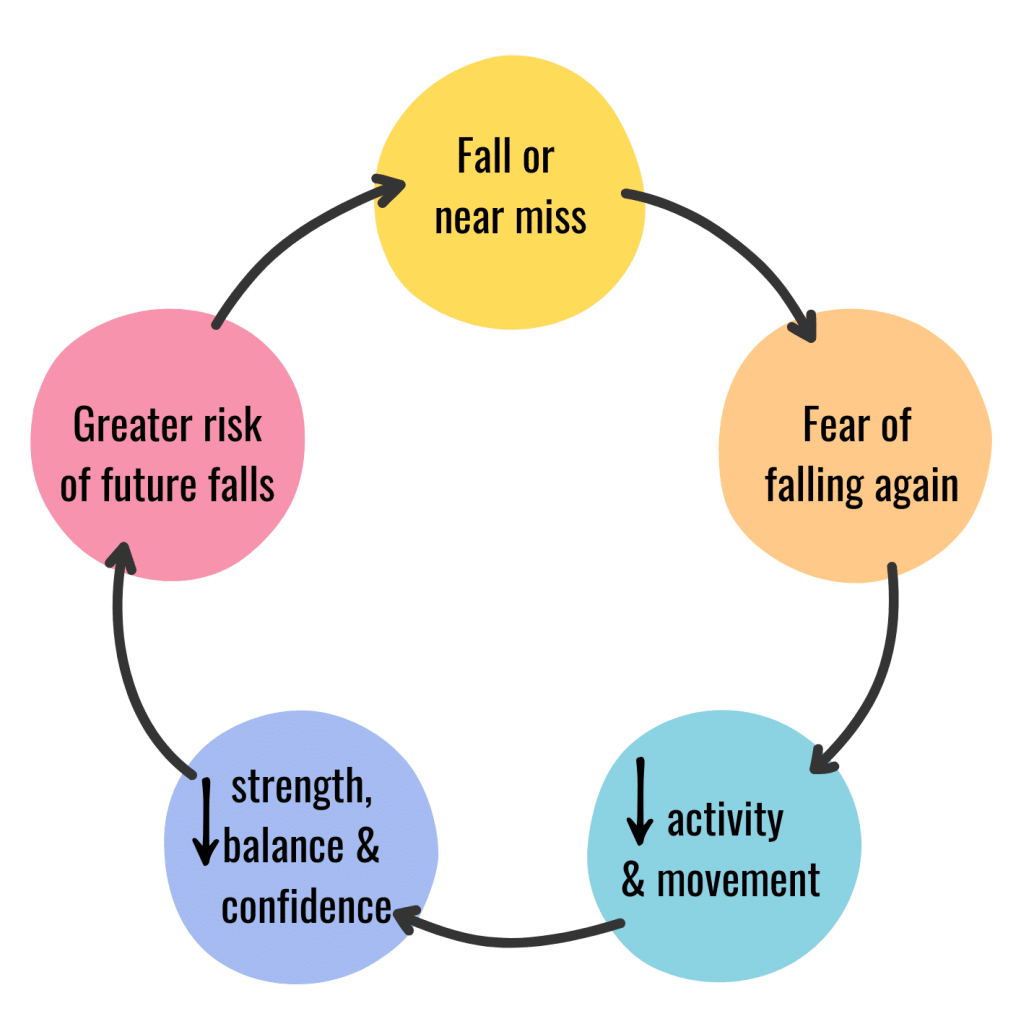
People have a fall, or a near miss, so they are understandably afraid of falling again, they do a bit less – maybe not going out as much, or moving more slowly, or not climbing the stairs as much, which results in them getting deconditioned making the risk of falls even greater.
What can you do to reduce your risk of falling?
There are five key actions to reduce the risk of falling:
- Build strength: Strong legs help us stand, walk, climb stairs and recover our balance.
- Challenge your balance: Balance improves when we practise activities that safely challenge it. Just like building muscle strength, improving balance requires us to challenge our body.
- Keep moving: Regular physical activity helps maintain mobility and independence.
- Check your environment and health: Review medications, eyesight, footwear, lighting and trip hazards.
- Seek help early: Don’t wait until you’ve had a serious fall before getting advice.
We need to make sure exercise is sufficiently challenging. If an exercise is too easy, it is unlikely to make much difference. The challenge is finding the right level of difficulty – enough to encourage improvement, but not so difficult that we risk falling.
It is important that when you are challenging your balance with exercises that you have support nearby such as a kitchen worktop in front of you and a sturdy chair behind you. I always say to make sure the worst that can happen is that you sit down in a chair. The last thing you want is to have a fall when you are doing balance exercises – your brain will give even more resistance to exercising if that happens!
Falls prevention is more than just practicing walking (although this is important!), it is about progressively challenging strength and balance to make sure all the systems are working together in the best way possible.
What if you have a neurological condition?
Neurological conditions such as Parkinson’s, stroke and multiple sclerosis can affect balance in different ways. You may experience muscle weakness, altered sensation, slower reactions or difficulties coordinating movement.
The good news is that even when someone has a long-term neurological condition, there are often ways to improve their balance, mobility and confidence. The key is understanding exactly what is causing their difficulties and developing an individual rehabilitation programme.
How can physiotherapy help?
At Neurobility, we know that no two people fall for exactly the same reasons. That’s why we take time to understand what’s happening, what might be contributing to your difficulties and, most importantly, what you want to be able to do. We make sure we have the full picture by looking at the following –
- When, where and why falls and near misses happen.
- Muscle strength, walking pattern, balance and reactions.
- Modifiable risk factors, possibly including a risk assessment of your home environment.
- Possibly an assessment of your Vestibular Function – the balance systems in the inner ear.
All of this will help us to build a tailored exercise and rehabilitation programme specific to the needs of the individual. Our mission is to build confidence and help people continue doing the activities that matter to them.
Stay strong, steady and independent
Getting older, or living with a neurological condition doesn’t have to mean giving up the activities you love. Whether you’re worried about your balance, have experienced a fall or simply want to stay strong and independent for longer, taking action now can make a real difference.
If you’re concerned about your balance, have experienced a fall or are finding yourself becoming less confident on your feet, we’re here to help.
At Neurobility, our specialist physiotherapy team helps people improve their strength, balance and confidence so they can continue doing the things that matter to them.
You don’t have to wait until you’ve fallen to ask for help. Contact us to find out how we can help, or ask about our exercise classes.
